

Revolutionizing Military Operations
As the landscape of global warfare evolves, the U.S. military stands at the forefront of innovation with its aggressive push to integrate artificial intelligence (AI) into its operations. This bold initiative is seen as a potential game-changer, aiming to enhance decision-making and operational efficiency on the battlefield. Yet, within these advancements lie voices of caution from military leaders who advocate for a thoughtful approach to AI deployment.
Voices of Caution Amidst Rapid Innovation
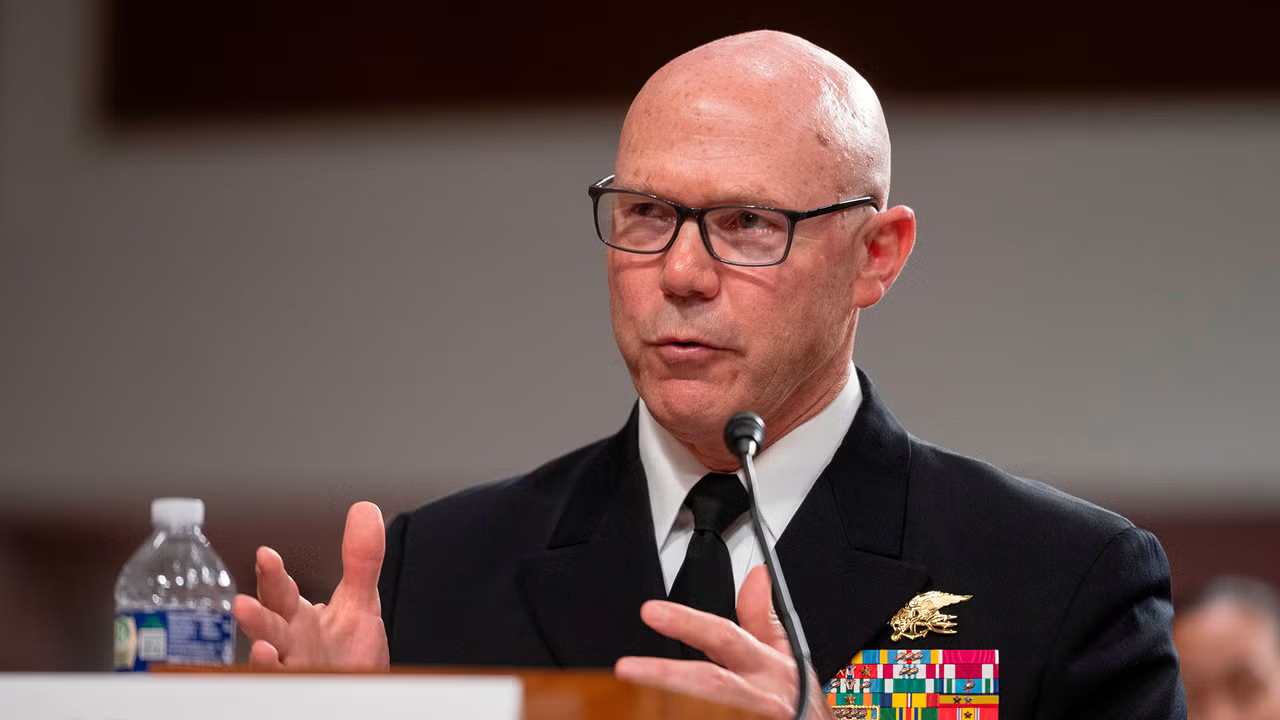
Admiral Frank Bradley, the commander of U.S. Special Operations Command, recently articulated a balanced view of AI’s potential in military contexts during a special forces conference in Tampa, Florida. While he recognizes the transformative capabilities of AI, he emphasizes the necessity of strict oversight to ensure that these technologies are used responsibly. Bradley poignantly stated that AI must not only enhance military effectiveness but also guarantee the precision of lethal actions, preserving the integrity of human judgment in the decision-making process.
This sentiment is echoed by other leaders within the military, who stress that AI should serve as an augmentative tool rather than a replacement for human intuition. According to Melissa Johnson, the top acquisition official for U.S. Special Operations Command, AI should alleviate the cognitive burden associated with routine tasks, allowing operators to focus on more critical aspects of their missions.
The Divergent Perspectives on AI Utilization
The debate surrounding AI in military applications highlights a dichotomy within the Pentagon. On one side, there is a clear push from Defense Secretary Pete Hegseth for unrestricted access to AI technologies, encouraging their use in any legal capacity to maintain a strategic advantage over global adversaries. This approach, however, raises concerns among tech companies and ethicists about the potential repercussions of fully autonomous systems, particularly regarding civilian safety and ethical implications.
Conversely, leaders like Bradley advocate for a nuanced understanding of AI’s role, suggesting it can enhance operational capabilities without diminishing the ethical standards that govern military conduct. The discussions illustrate a broader tension: the need for speed and efficiency in military operations versus the imperative of maintaining ethical safeguards in the rapidly advancing technological landscape.
AI as a Strategic Asset
While the integration of AI into military strategies presents challenges, it also offers significant advantages. AI’s potential to process vast amounts of data quickly allows for more informed decision-making on the battlefield. For instance, Lt. Gen. Michael Conley of the Air Force Special Operations Command highlighted the successful use of AI technologies to streamline intelligence sharing, enhancing operational effectiveness during complex missions.
Moreover, a recent study showcased how AI-enabled systems have enabled military units to execute artillery strikes with remarkable efficiency, demonstrating that AI can indeed bolster military effectiveness when utilized judiciously. As Helen Toner from Georgetown University points out, the potential applications of AI within the military extend beyond combat scenarios and can significantly improve bureaucratic processes, thereby enhancing overall operational efficiency.
Ethics and Accountability in the Age of AI
The ongoing discussions about AI’s role in military operations underscore an essential truth: the ethical implications surrounding autonomous systems cannot be overlooked. The Pentagon’s engagement with technology firms like Anthropic has stirred controversy, particularly regarding the constraints imposed on AI applications. This friction has raised alarms about the potential for unchecked military use of AI technologies, particularly concerning the ethical dilemmas associated with fully autonomous weaponry and surveillance systems.
As the Pentagon navigates these challenges, the need for clear ethical frameworks becomes paramount. The military’s commitment to ensuring that human decision-making remains at the forefront of lethal operations is crucial in maintaining accountability. As Toner notes, military commanders are driven by the imperative to succeed in their missions while minimizing the risks of unintended consequences, such as civilian casualties or misidentifying targets.
Charting a Course Forward
The integration of AI into military operations embodies a complex interplay of innovation, ethics, and strategic advantage. As the U.S. military advances its AI capabilities, the importance of responsible oversight and ethical considerations cannot be overstated. The dialogue between military leaders, technology firms, and ethicists is essential in shaping a future where AI enhances military effectiveness while adhering to the principles of accountability and human oversight.
In this era of rapid technological advancement, the U.S. military’s approach to AI will serve as a benchmark for other nations grappling with similar challenges. The balance between leveraging technology for strategic advantage and ensuring ethical integrity will define the future of warfare and military operations globally.
Editorial note: This article was created by A Bit Lavish Miami’s Magazine as an original editorial reinterpretation based on publicly available reporting. Original source: fastcompany.com. Read the original article here: https://www.fastcompany.com/91551598/pentagon-pushing-ai-battlefield-top-military-leader-urging-caution.
Images are used for editorial reference with source credit. If an image requires correction or removal, please contact A Bit Lavish.









Limited-Time Kamaʻāina Discounts Announced at Hyatt Buffet
Hyatt's discount initiative highlights the importance of local tourism recovery amidst ongoing...
 1 Mins read

Freddy Krueger Returns to Pop Culture Spotlight Amidst Global Nostalgia
The resurgence of Freddy Krueger reflects a significant cultural moment, highlighting evolving...
1 Mins read

The Transformative Power of AI: Insights from JPMorgan’s Leadership
JPMorgan Chase's CEO Jamie Dimon discusses the impact of AI on employment...
2 Mins read



A New Era in Sports Broadcasting: Elevating Women Athletes Beyond the Lens
Explore how new broadcasting guidelines aim to reshape the portrayal of women...
2 Mins read
