
Yacht Charter , Superyachts , MegayachtsYachts
 ABLUpdated 1 year Ago8 Mins read543
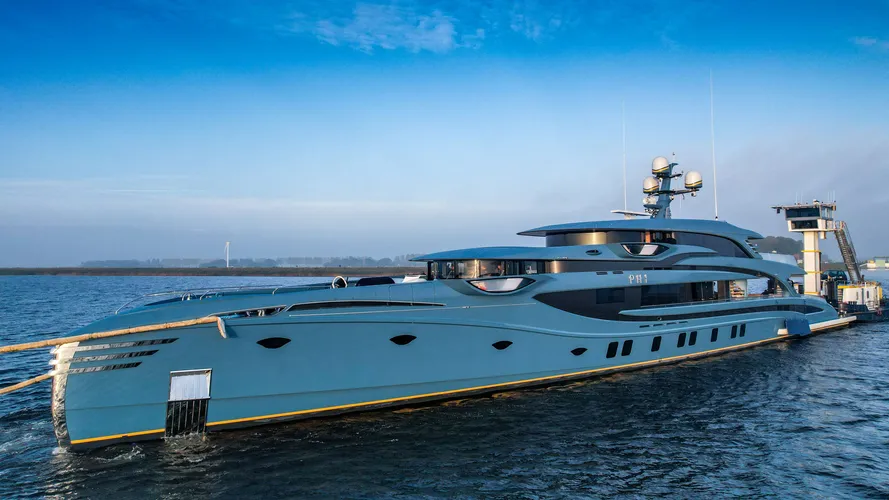
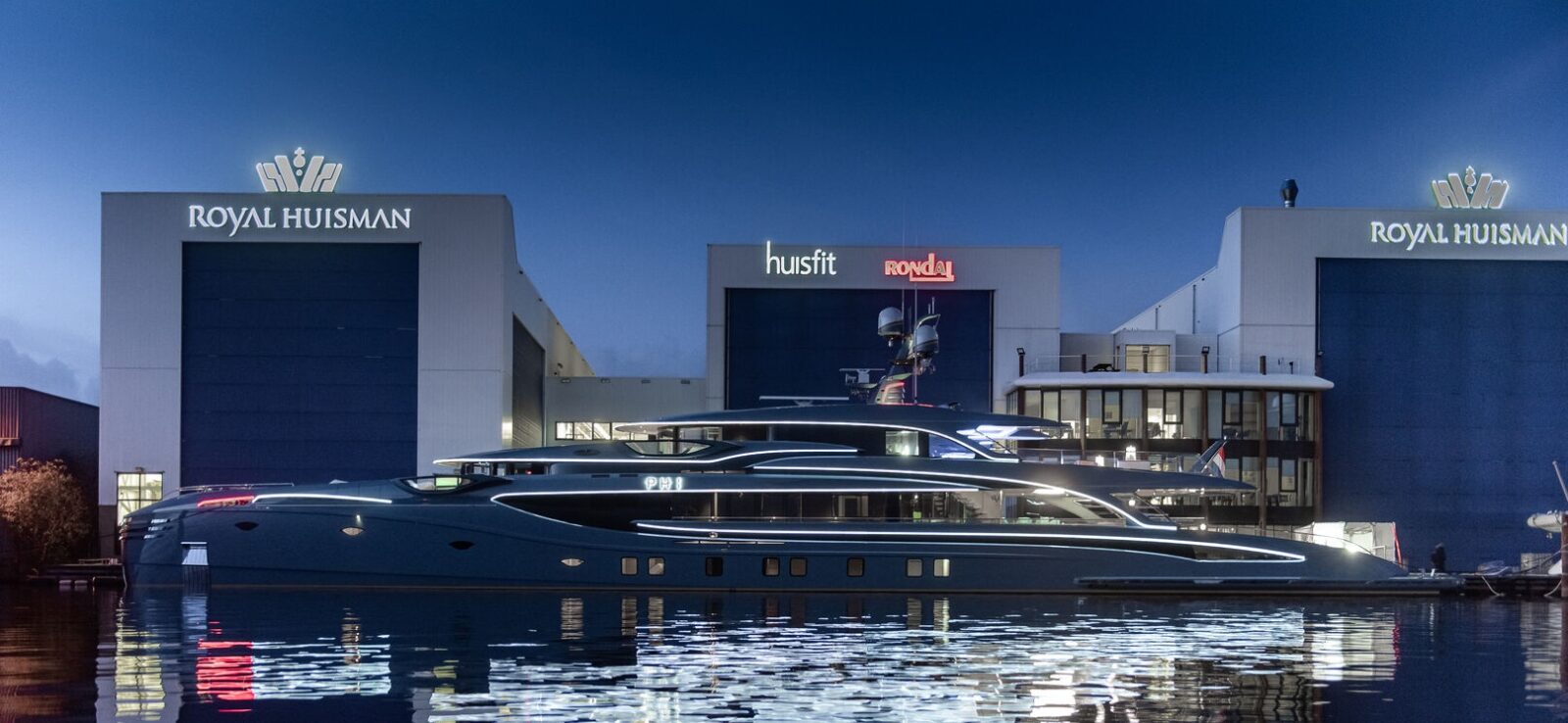
Phi yacht (Royal Huisman, 58.5m, 2021)
The Superyacht That Pushed AI Boundaries — and UK Authorities’ Buttons
ABLUpdated 1 year Ago8 Mins read543
Share
A Legal Precedent at Sea
On July 29, 2025, the United Kingdom’s Supreme Court upheld a controversial decision to detain the 58.5-meter Royal Huisman motor yacht Phi. The court rejected the appeal by Dalston Projects Ltd., the yacht’s registered owner, concluding that the detention was lawful, proportionate, and aligned with the public interest.
The vessel has remained moored in London’s Canary Wharf since March 2022, when then-Transport Secretary Grant Shapps ordered her detention under the Russia (Sanctions) (EU Exit) Regulations 2019. Authorities argued that although Sergei Naumenko, Phi’s beneficial owner, is not on the official sanctions list, he remains a Russian citizen and could indirectly benefit from the yacht’s operations, such as charters or resale.
This ruling marks a milestone in how governments may handle assets linked to geopolitical tensions. The five Supreme Court justices unanimously agreed that economic sanctions could extend to indirect beneficiaries, and that proof of ownership is not the sole criterion in such decisions. The court also rejected the claim that the yacht’s detention constituted “conversion”—the unlawful taking of property.
Initially, officials justified the hold as part of Russian sanctions enforcement. In March 2022, then-Transport Secretary Grant Shapps ordered the yacht’s detention, making it “the first detention of a superyacht in UK waters” under the new sanctions regime.
For over three years, the 192-foot vessel sat idle, unable to set sail while its owner waged – and lost – multiple court battles to free it. Just this week, Britain’s Supreme Court unanimously upheld the detention as lawful, dashing the owner’s final appeal.
It’s a saga brokers and owners have watched closely – after all, a yacht of this caliber commands up to €650,000 per week in charters, income now lost to a seemingly indefinite port arrest.
But beyond the geopolitical headline, an intriguing twist lurked below deck.
This wasn’t just any yacht – it was rumored to be equipped with an advanced AI system integrated into its onboard operations. In other words, the UK didn’t simply detain a yacht; it detained what may be one of the first AI-augmented superyachts on the seas.
And that raises a question reverberating across the maritime community:
Are authorities prepared for the age of AI at sea?

Phi’s Innovation and Identity
Delivered in 2021 by Royal Huisman, Phi is not merely a pleasure craft—it is a showcase of innovation. At 58.5 meters in length, she features exterior styling by Cor D. Rover, naval architecture by Van Oossanen, and interiors by Lawson Robb. She boasts an internal volume of 495 GT and accommodates 12 guests across six staterooms.
Beyond her elegant design, what sets Phi apart is her rumored integration of artificial intelligence systems. Although full technical details have not been disclosed, industry whispers point to AI-driven functionalities, such as:
- Predictive maintenance algorithms
- AI-assisted navigation and routing
- Environmental data modeling
- Smart guest personalization systems
AI Onboard: Innovation Under Scrutiny
The detained superyacht Phi during earlier sea trials. Advanced technology onboard – including AI-driven systems – has made her a focal point in the industry.
Artificial intelligence on a luxury yacht is no longer the stuff of science fiction or marketing hype – it’s today’s reality. “Artificial intelligence isn’t coming to the yachting industry — it’s already here,” as one industry expert put it. From bridge to engine room, AI is transforming how modern yachts operate, and even how they cater to their owners.
Take the latest concept from Italy’s Rossinavi shipyard: the Solsea hybrid-electric catamaran. It boasts an onboard AI so sophisticated it can “predict a guest’s every move” to personalize the experience. Imagine a yacht that adjusts lighting, climate, or music in anticipation of your mood – that’s no longer a futuristic fantasy but an emerging standard in ultra-luxe design.
On the practical side, Solsea’s AI actively manages the vessel’s systems. It continuously monitors the battery banks, optimizes performance, and even advises crew on maintenance to extend the life of critical components. In essence, the yacht itself is learning and adapting in real time – a floating smart home with propellers.
It’s easy to see why owners are smitten with these advancements. AI promises smoother operations, lower costs, and enhanced safety. Predictive maintenance algorithms can spot a mechanical issue before it becomes a failure. Intelligent navigation aids can plot routes around rough weather. Experimental AI fire detectors can identify hazards far earlier by analyzing heat and smoke signatures – potentially preventing catastrophic fires onboard.
In the superyacht arms race of innovation, AI is the new turbocharger. And builders are racing to infuse it wherever they can, heralding a new era of “smart yachts.”
However, this particular detained vessel’s brush with the law highlights a looming reality: innovation often races ahead of regulation.
It’s one thing to quietly install AI-enhanced systems on a new build; it’s another when those systems draw government attention. Sources close to the matter suggest British authorities took a very keen interest in the yacht’s experimental AI-driven bridge controls and data systems.
Was the AI merely an efficiency booster – or could it pose a risk to privacy, security, or even international law?
The UK, it seems, wasn’t taking chances. And that cautious stance speaks volumes to those of us watching the intersection of tech and yachting.
Why the UK Is On High Alert
The United Kingdom has signaled in recent years that it will not remain a passive bystander to the AI revolution – especially where misuse or risks are involved. This is the same country that moved aggressively to detain yachts of sanction-linked billionaires, turning symbols of opulence into leverage over global events. Now, British regulators are similarly proactive about technology on these floating palaces.
Just as illicit financial dealings or sanctioned owners raise red flags, so might an uncertified AI system running a ship at sea. UK lawmakers and maritime officials are keenly aware that a superyacht isn’t just a private toy; it can be a 400-foot gadget packed with advanced electronics, sensors, and now self-learning software. All that technology blurs the line between a conventional crewed vessel and something more autonomous – something not fully accounted for in today’s maritime laws.
Notably, the UK has already criminalized certain malicious uses of AI. Deepfake videos – those eerily convincing yet fake yacht collision clips circulating online – have become a concern for brand reputation and public safety. Britain has made it a criminal offense to create harmful deepfakes and other digital malfeasance, even threatening prison time for offenders. This tough stance contrasts with places like the U.S., where comprehensive AI laws still lag behind.
The message is clear: in the UK’s view, if you misuse AI, expect consequences. That philosophy likely extends to the maritime realm. If an AI aboard a yacht could, say, violate privacy (imagine clandestine surveillance of VIP guests), interfere with navigation, or operate beyond the scope of safety certifications – it’s bound to raise eyebrows in Whitehall and beyond.
There’s also a national security undercurrent. A superyacht’s AI systems – high-powered computers, communication arrays, maybe even autonomous drones – could conceivably be repurposed for less peaceful ends. It’s no secret that some cutting-edge yacht tech overlaps with defense or intelligence domains.
The UK, fresh off establishing a “Kleptocracy Cell” to combat illicit Russian assets, is attuned to any unconventional tool that might be on these vessels. An ultra-modern yacht with unknown AI capabilities might as well be a spaceship entering port – authorities will want to inspect it.
As one British maritime official privately quipped, “We’re not about to let someone’s private navy set sail autonomously past the Thames.” Half in jest, perhaps – but only half.
A Game-Changer for Superyacht Construction
Beyond the immediate legal drama, this incident could be a watershed moment for the yacht industry. The detention has effectively put builders, naval architects, and tech suppliers on notice: AI integration is a game-changer, and we must treat it as such.
Until now, the design of superyachts has been governed by classification society rules and international conventions – many of which assume humans are firmly at the helm. But those assumptions are shifting. Lloyd’s Register, a leading classification society, has acknowledged that “in classification terms… there is no class society–assured autonomy yet. Full stop.” In other words, there’s no clear rulebook (yet) for a yacht that pilots itself or an AI system making safety-critical decisions.
Yacht Phi’s fate may prompt class societies and the IMO to accelerate efforts on AI guidelines, much like the emergence of steamships or jet skis once forced the creation of new regulatory frameworks.
Design-wise, we could soon witness yachts built around AI from the keel up. Future superyachts might feature “AI control rooms” or redundant AI-driven systems with multiple failsafes to satisfy surveyors. We’re already seeing concept designs like Solsea embrace AI as a core feature rather than an afterthought.
The benefit? A vessel that can operate with a smaller crew – or even be remotely supervised, as experimental ships in Norway and Japan are already demonstrating. Naval architects are now envisioning sleek profiles freed from the need for large crew quarters or bridge wings, since an AI requires neither sleep nor a view. Spaces once reserved for captain’s cabins might soon become AI server rooms or additional luxury amenities for the owner. It’s a radical reimagining of yacht architecture – one loaded with both promise and pitfalls.
For owners and brokers, these advancements bring a mix of excitement and uncertainty. On one hand, an AI-augmented yacht offers bragging rights and potentially lower operating costs through reduced crew needs, smarter fuel management, and predictive maintenance.
On the other hand – will such a yacht be insurable? Will it be allowed to dock in certain ports or sail under specific flags without new certifications? These practical questions are becoming increasingly urgent.
The UK’s hard line signals that even if the technology is ready, the regulatory climate may not be – and that could impact a yacht’s value and its freedom to roam.








Related Articles
Yachts  2 Mins read
The GX42: A New Era in Luxury Yachting
Explore the debut of the GX42, the first model from GX Superyachts,...
2 Mins read
Yachts 2 Mins read
Navigating the Future: Simrad’s NSO 4 Multifunction Displays Set to Redefine Yachting Technology
Discover how Simrad's NSO 4 multifunction displays elevate yachting technology with advanced...
2 Mins read
Yachts ABL2 Mins read
Saxdor Yachts Unveils the Open 460 GTS: A New Era in Luxury Boating
Discover the Saxdor 460 GTS, a flagship yacht designed for open-water enthusiasts,...
ABL2 Mins read


Yachts ABL3 Mins read
Experience Unparalleled Luxury Aboard the Fountaine Pajot MY6
Explore the Fountaine Pajot MY6, a luxurious catamaran offering exceptional comfort and...
ABL3 Mins read
