

The AI Evolution: A Gradual Shift
As we stand witness to a flurry of headlines heralding the transformative power of artificial intelligence, one might be led to think that AI will reshape society overnight. Yet, the reality is more nuanced. The adoption of AI across corporate America is not occurring at the expedited pace many anticipate; instead, it is a steady, almost methodical journey. While the technology sector takes the lead, the broader corporate landscape remains in a state of cautious exploration, particularly among non-tech firms that account for the majority of the U.S. economy.
Current State of AI Integration
Recent assessments reveal that less than 25% of S&P 500 companies have integrated AI deeply into their operational frameworks or are utilizing it extensively in their service production. This statistic underscores a significant lag in AI deployment outside the technology realm, where only a handful of firms—such as Moderna and Mastercard—have achieved full AI integration. As these statistics illustrate, while technology firms dominate the stock market, a considerable reservoir of untapped potential resides within non-technology sectors, waiting to be unlocked.
Driving Factors for AI Adoption
What will catalyze the broader integration of AI across industries? Continuous technological advancements will play a pivotal role. For AI to effectively revolutionize workplace operations, it must deliver high precision and be cost-effective. Currently, many AI models fall short of these benchmarks, often standing as a promise of future capabilities rather than a present reality. However, promising trends indicate that improvements are on the horizon. For instance, large language models (LLMs) have shown remarkable progress in completing complex tasks with increasing accuracy, suggesting that we may be on the brink of a significant breakthrough in AI functionality.
AI in Action: Practical Applications
Consider a national supermarket chain managing an extensive inventory of 50,000 stock-keeping units across 500 locations. The challenge of accurately forecasting demand can be daunting, especially in a low-margin business model. Leveraging AI for precise demand forecasting not only enhances operational efficiency but also reduces waste, ensuring that inventory aligns more closely with consumer preferences. In industries like manufacturing and construction, AI can streamline project management processes by providing real-time updates on budgets and timelines, enhancing productivity and resource allocation.
Redefining Work: The Human-AI Collaboration
The integration of AI into business practices is more than just a technological upgrade; it necessitates a cultural shift within organizations. As firms adapt their operations, the need for a workforce that embraces new roles alongside AI will become crucial. While there is a valid concern regarding job displacement, the narrative should shift towards the potential for AI to complement human effort rather than replace it. By fostering environments that encourage collaboration between technology and talent, companies can drive innovation and develop new products and services that resonate with market demands.
A Slow Yet Promising Transition
Despite the current pace of AI adoption, it is essential to recognize that corporate America is at the precipice of a significant transformation. While many organizations encounter hurdles such as data accessibility and customization challenges, these obstacles are not insurmountable. Over time, as more executives observe the tangible benefits of partial automation—where AI handles certain tasks while humans oversee others—the momentum toward broader AI adoption will inevitably accelerate. This gradual shift is characterized by a ‘J-curve’ effect on profitability, where later adopters tend to reap greater financial rewards, further incentivizing AI integration.
Looking Ahead: The Future of AI in Business
As we gaze into the future, the timeline for widespread AI adoption remains uncertain. However, one thing is clear: corporate America is poised to transition from the slow lane to a more dynamic engagement with AI technologies. As the journey unfolds, businesses that navigate this landscape with foresight and adaptability will find themselves at the forefront of innovation, ready to harness the full potential of artificial intelligence.
Editorial note: This article was created by A Bit Lavish Miami’s Magazine as an original editorial reinterpretation based on publicly available reporting. Original source: fastcompany.com. Read the original article here: https://www.fastcompany.com/91595338/corporate-america-is-embracing-ai-slower-than-the-hype-suggests-but-the-pace-is-increasing.
Images are used for editorial reference with source credit. If an image requires correction or removal, please contact A Bit Lavish.








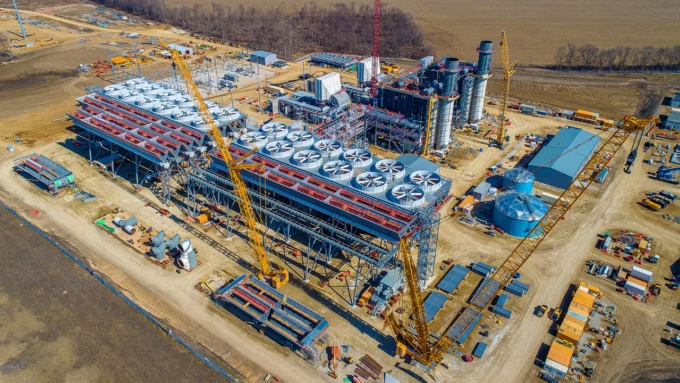
The Gas Renaissance: U.S. Data Centers Drive a New Era of Energy Development
Explore how America's data center surge is reshaping the gas power landscape,...
 ABL2 Mins read

Mastering the Art of Inquisitive Engagement: Elevating Conversations in Miami’s Boardrooms
Explore how to transform your meeting dynamics by asking impactful questions that...
ABL3 Mins read

US Economy Grows at 1.5% in Second Quarter, Confirming Earlier Estimates
The US economy's growth rate of 1.5% in Q2 underscores ongoing challenges...
 1 Mins read



U.S. Second Quarter GDP Growth Holds Steady at 1.5% in Revised Estimates
The confirmation of 1.5% GDP growth underscores ongoing economic challenges and inflationary...
1 Mins read

Leave a comment