

Unmasking the Digital Illusion
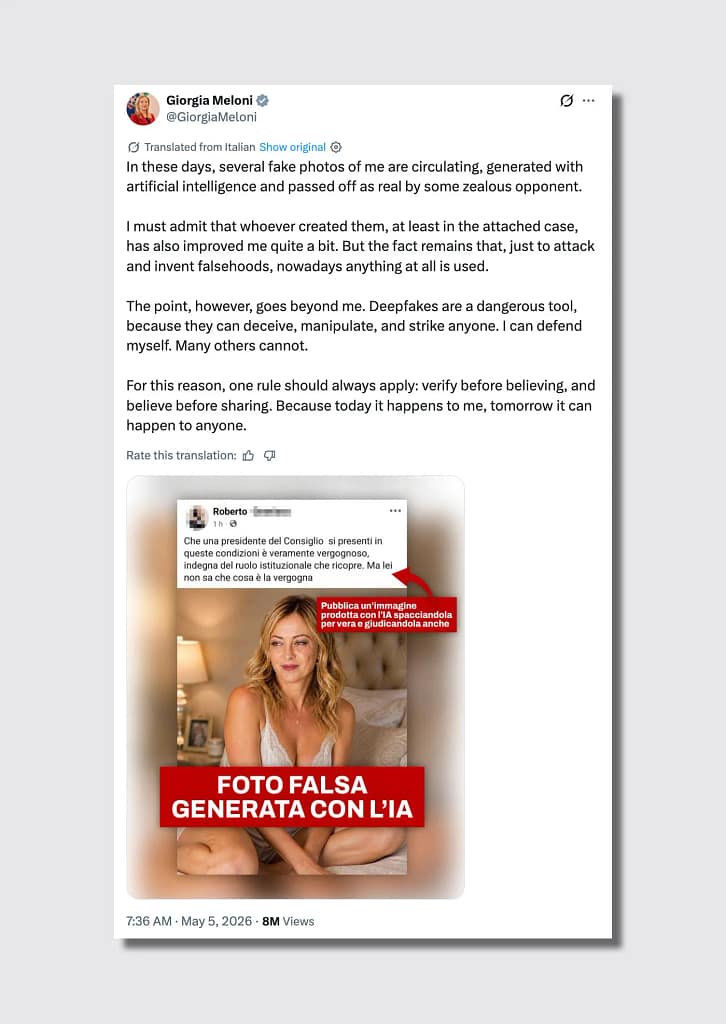
In a striking move that has stirred conversations worldwide, Italian Prime Minister Giorgia Meloni recently shared an AI-generated image of herself in lingerie on X, formerly known as Twitter. While the image is not a deepfake in the traditional sense, it serves as a provocative illustration of the capabilities of generative AI. Meloni’s intent was clear: to alert the public to the alarming ease with which synthetic media can be produced, urging individuals to question the authenticity of what they see online.
“Never believe anything you see without thoroughly fact-checking it,” she cautioned, encapsulating the precarious state of our reality where misinformation can be just a click away. The prime minister’s experience with AI-generated content is not isolated; it reflects a growing concern among leaders about the potential misuse of technology to manipulate perceptions and sway public opinion.
A New Era of Misinformation
The implications of generative AI extend far beyond individual experiences. As Meloni pointed out, the dissemination of misleading images and videos can deceive, manipulate, and harm. The rise of figures like Jessica Foster, an AI-generated influencer who attracted a massive following despite obvious rendering flaws, illustrates how easily people can be seduced by digital facades that cater to their ideological leanings.
This phenomenon raises critical questions: How do we discern fact from fiction in a digital landscape saturated with manipulated content? When legitimate footage, such as the recent video of Israeli Prime Minister Benjamin Netanyahu, is dismissed as a deepfake despite verification from independent analysts, it highlights the urgent need for a collective strategy to preserve our shared reality.
The Call for Innovative Solutions
Meloni’s message resonates not just in Italy but globally. The solutions to combat the challenges posed by synthetic media require both innovative technological approaches and robust legal frameworks. Currently, the landscape is fragmented, with public awareness campaigns proving insufficient against the sophisticated tactics of misinformation.
Experts from ETH Zurich have proposed a groundbreaking solution: sensors that cryptographically sign images and audio at the moment of capture, ensuring authenticity is embedded within the media itself. This approach would significantly reduce the likelihood of synthetic media being mistaken for real, offering a beacon of hope amid the chaos.
Legislative Action and Its Necessity
To further bolster this technological solution, legislative measures must be enacted to empower individuals against unauthorized AI representations. The Danish government has already taken a commendable step in this direction by granting citizens ownership rights over their biological likenesses and voices. Such legislation serves as a model for other nations grappling with the rise of AI-generated content.
As Meloni aptly noted, the real fight lies in ensuring that individuals can protect their identities and reputations in a landscape where their likeness can be easily exploited. The urgency of the situation cannot be overstated; without proactive measures, the boundary between reality and fabrication will continue to erode.
A Shared Responsibility
The responsibility to address the challenges posed by generative AI does not solely rest on governments. Tech giants also bear a significant burden to develop ethical frameworks and technologies that prioritize user safety and trust. The current state of affairs, where misinformation spreads unchecked for profit, is untenable.
As we navigate this complex landscape, it is essential for stakeholders across industries to collaborate on solutions that ensure authenticity in digital media. The prioritization of truth over sensationalism will require a cultural shift alongside technological advancements, fostering a society where skepticism is balanced with informed understanding.
Conclusion: Embracing the Future with Vigilance
The emergence of generative AI presents both challenges and opportunities. As Meloni’s bold statement underlines, we are at a critical juncture where the preservation of our collective reality demands immediate action. The onus is on us all—governments, tech companies, and citizens alike—to advocate for a future where authenticity prevails, enabling a digital landscape that reflects our shared truths rather than our fears. In the face of pervasive misinformation, vigilance and proactive engagement will be key to navigating the murky waters ahead.
Editorial note: This article was created by A Bit Lavish Miami’s Magazine as an original editorial reinterpretation based on publicly available reporting. Original source: fastcompany.com. Read the original article here: https://www.fastcompany.com/91537698/giorgia-meloni-outsmarted-ai-abusers-by-posting-surprising-image.
Images are used for editorial reference with source credit. If an image requires correction or removal, please contact A Bit Lavish.







Cultivating Trust: The Art of Thriving in a New Workplace
Explore essential strategies for building trust and rapport with colleagues in a...
 2 Mins read

Navigating the AI Communication Conundrum: Are We Losing Our Voices?
Exploring the impact of AI on workplace communication, the dangers of outsourcing...
2 Mins read

Empowering the Future: Salesforce’s Bold Commitment to AI-Native Talent
Salesforce's latest initiative to hire 1,000 recent graduates with AI fluency reflects...
 ABL3 Mins read


When Memes Meet Marketing: The Rise and Fall of ‘Date Cancelled’
Explore the fascinating journey of the 'date cancelled' meme, its cultural resonance...
ABL3 Mins read
Leave a comment