
A Culinary Canvas: The Return of a Monumental Art Piece in Times Square
 ABLUpdated 1 month Ago3 Mins read59

A Reflection of American Culture
In the heart of New York City, where art and daily life converge in an exhilarating dance, a familiar yet striking piece re-emerges: Jen Catron and Paul Outlaw’s monumental installation, “Hot Dog in the City.” Measuring an impressive 65 feet in length, this vibrant sculpture serves as a captivating commentary on Americana, replete with rich symbolism and contemporary relevance.
The timing of its reappearance could not be more poignant, coinciding with the 250th anniversary of the United States. This occasion not only marks a celebration of the nation’s birth but also underscores the cultural tapestry that defines its identity. The hot dog—a quintessential American culinary creation—embodies the spirit of American life, uniting people from all walks of life under the banner of shared experiences and nostalgia.
Artistic Ingenuity and Whimsical Design
Catron and Outlaw have masterfully crafted a piece that transcends mere representation. The “Hot Dog in the City” is not just a sculpture; it is an immersive experience. Adorned with cheerful toppings that evoke a sense of festivity and patriotism, the artwork challenges viewers to reconsider the ordinary. The bright colors and exaggerated forms invite audiences to engage with the piece, sparking joy and curiosity as they navigate its dimensions.
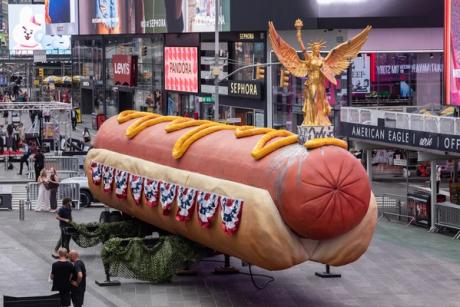
The artists’ choice to emphasize toppings laden with national significance adds a layer of depth to the work. Each embellishment can be seen as a nod to the diverse culinary landscape that America embodies, celebrating the multitude of cultures that have contributed to its identity. It serves as a reminder that art can emerge from the most unexpected sources, transforming everyday items into extraordinary cultural commentary.
The Intersection of Art and Commerce
In an ever-evolving art market where the lines between commercialism and artistic expression blur, Catron and Outlaw’s work stands as a beacon of originality. The installation occupies a unique position within the art world, one that allows it to engage a broad audience while also holding significant investment value. Public art, especially in a bustling locale like Times Square, often garners attention that can translate into market interest.
As collectors and investors increasingly seek pieces that resonate on a cultural level, the “Hot Dog in the City” exemplifies the dual nature of contemporary art: it is both a visual feast and a potential asset. The work’s rarity and the artists’ growing legacy contribute to its desirability, making it a noteworthy addition to any collection focused on innovative, meaningful art.
Collector Psychology: The Allure of Public Art
The psychology behind art collecting is complex, often intertwined with emotional and experiential connections. For many, acquiring a piece of art is not merely a financial decision; it is a personal journey that reflects individual tastes and values. Public art, in particular, invites interaction, creating a collective memory that enriches its cultural significance.
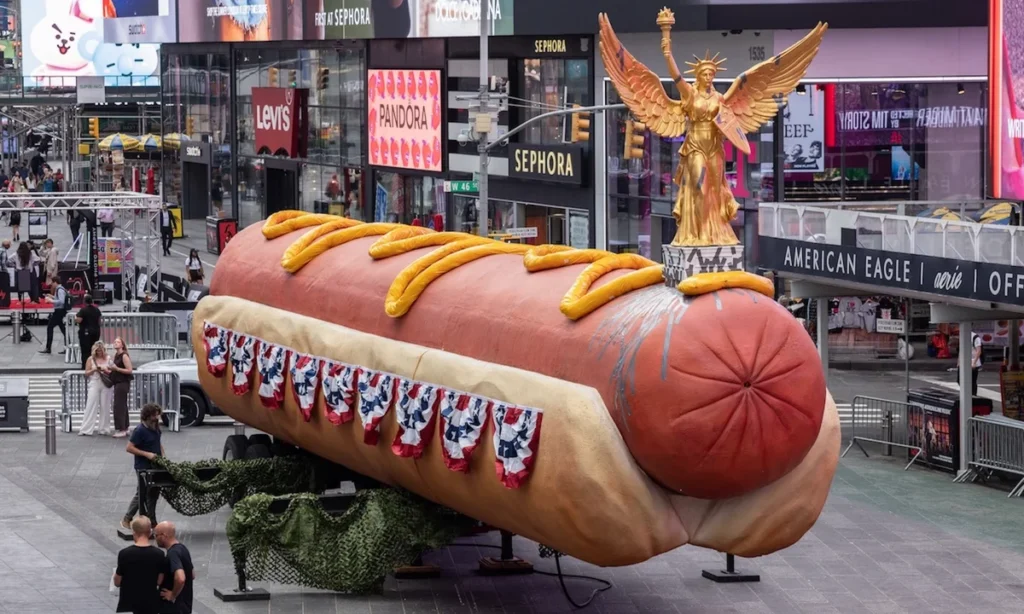
As the “Hot Dog in the City” captivates passersby in Times Square, it fosters a sense of community and shared experience. The work not only serves as a conversation starter but also as a marker of cultural relevancy, allowing collectors to engage with a piece that resonates beyond the gallery walls. For collectors who appreciate the narratives woven into contemporary art, this installation presents an opportunity to invest in a piece that captures the essence of an era.
Legacy and Future Directions
The legacy of Jen Catron and Paul Outlaw continues to evolve as they push the boundaries of artistic expression. Their work challenges traditional notions of sculpture and invites viewers to explore familiar themes through innovative lenses. As their reputations grow, so too does the significance of their contributions to the contemporary art landscape.
The return of “Hot Dog in the City” to Times Square not only reaffirms the importance of public art but also highlights the artists’ commitment to engaging with American culture. As they explore themes of identity, community, and consumerism, their work remains pivotal in discussions about the role of art in society.
In a world where the dialogue surrounding art is more vibrant than ever, Catron and Outlaw’s installation serves as a playful yet profound reflection of the American experience. It invites all who encounter it to partake in a moment of joy, nostalgia, and reflection—reminding us of the beauty that can be found in the most unexpected places.
Editorial note: This article was created by A Bit Lavish Miami’s Magazine as an original editorial reinterpretation based on publicly available reporting. Original source: theartnewspaper.com. Read the original article here: https://www.theartnewspaper.com/2026/07/24/jen-catron-paul-outlaw-times-square-hot-dog-returns.
Images are used for editorial reference with source credit. If an image requires correction or removal, please contact A Bit Lavish.








Navigating Fantasy: The Allure of Rare Literary Cartography
Explore the captivating intersection of literature and cartography in an upcoming Zurich...
 3 Mins read

Cuauhtémoc Medina: Curatorial Visionary Set to Elevate Guatemala’s Bienal de Arte Paiz
Explore the profound impact of Cuauhtémoc Medina's curatorial approach as he prepares...
2 Mins read

Unveiling Deception: The Forgery Scandal Shaking the Art World
An in-depth exploration of the Giuliano Ruffini forgery scandal, its implications for...
2 Mins read



Transition at the Top: A New Era for the Art Gallery of Ontario
As Stephan Jost steps down from his role at the Art Gallery...
2 Mins read
