


The Evolution of Home Prices: A 40-Year Journey
Over the past four decades, the U.S. housing market has witnessed an extraordinary transformation, characterized by soaring home prices that have reshaped entire communities. Certain metropolitan areas have experienced these price surges to a staggering degree, reflecting a complex interplay of local economies, demographics, and geographic constraints.
Regional Disparities in Growth
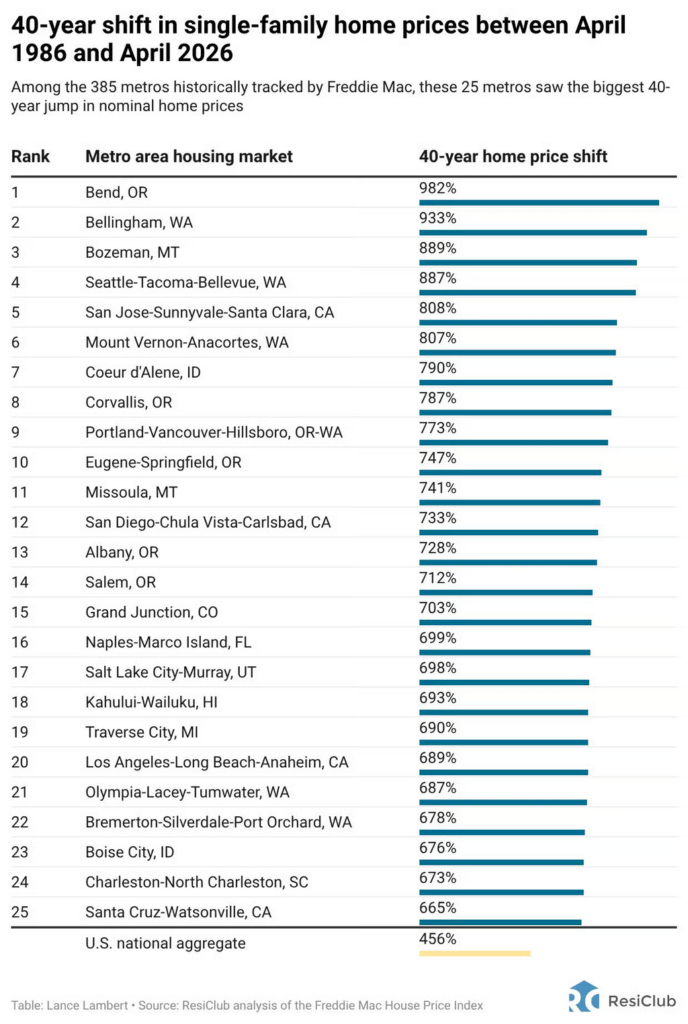
Among the standout performers, cities like Bend, Oregon, and Bellingham, Washington, have seen home prices skyrocket by nearly 1,000%. These figures illuminate a broader trend: the most significant gains are predominantly found in the western regions of the United States, particularly in the Pacific Northwest and Northern California. A remarkable 22 out of the 25 metro areas with the largest price increases lie west of the Mississippi River.
The Role of Income Growth
One of the critical drivers of this phenomenon is the robust wage growth that many of these cities have experienced, largely thanks to the expansion of high-paying industries such as technology and finance. Cities like Seattle-Tacoma exemplify this trend, where single-family home prices surged by 887% since 1986. The rise of tech giants like Microsoft and Amazon has not only created high-paying jobs but also attracted skilled workers from across the nation and beyond. This influx of talent has increased demand for housing, leading to higher prices.
Contrast in Economic Trajectories
In stark contrast, regions like Youngstown, Ohio, have struggled with economic stagnation and a decline in manufacturing jobs. With home prices rising only 297% in the same period, it’s clear that local income trajectories significantly influence housing markets. While both areas experienced similar national housing cycles, their divergent economic paths have resulted in drastically different outcomes for home prices.
The Supply-Demand Equation
The dynamics of supply and demand further complicate the housing landscape. In many high-demand western markets, the geographical constraints posed by mountains, coastlines, and protected lands, coupled with stringent land-use regulations, have made it challenging to build enough new homes to meet rising demand. This chronic under-supply has exacerbated price increases, creating a lag between demand and available housing stock.
Market Cooling and Future Outlook
Despite the long-term trends of growth, recent data suggests that several of these Pacific Northwest markets are experiencing cyclical cooling. Increased inventory and moderated price growth signal a potential shift, reminding stakeholders that the real estate market is inherently dynamic. The long-term winners may not always maintain their lead in the short term, as fluctuations can result from a multitude of factors including economic conditions, interest rates, and local policy changes.
Insights for Miami’s Housing Landscape
In Miami, the lessons drawn from these national trends are particularly relevant. As one of the fastest-growing cities in the U.S., Miami has attracted a diverse population and experienced significant wage growth, particularly in sectors like finance, technology, and real estate. However, the city faces its own set of geographic constraints and regulatory challenges that impact housing supply.
As Miami continues to evolve as a global hub, understanding the interplay of income growth and housing supply will be crucial for stakeholders looking to navigate the complexities of the local market. The ongoing dialogue around land use and development in Miami will shape the future of its housing landscape, potentially mirroring the successes and challenges observed in other high-growth cities across the nation.
Editorial note: This article was created by A Bit Lavish Miami’s Magazine as an original editorial reinterpretation based on publicly available reporting. Original source: fastcompany.com. Read the original article here: https://www.fastcompany.com/91571868/housing-market-home-prices-40-year-shift-markets-went-parabolic.
Images are used for editorial reference with source credit. If an image requires correction or removal, please contact A Bit Lavish.









Navigating the AI Frontier: Keeping Your Data Private in a Digital World
Explore innovative tools that safeguard your data while leveraging artificial intelligence, ensuring...
 3 Mins read

Bombay High Court Criticizes Drug Regulatory Body for Cipla License Revocation
The Bombay High Court's rebuke of India's drug regulatory authority highlights critical...
1 Mins read

A New Wave of Disruption: The Digital Camouflage Shirt and the Future of Adversarial Fashion
Explore how Simon Weckert's Digital Camouflage shirt challenges AI surveillance systems and...
2 Mins read



Navigating the AI Landscape: Understanding Proprietary, Open Weight, and Open Source Models
Explore the distinctions between proprietary, open weight, and open source AI models,...
3 Mins read
