
The Diplomatic Stage: Trump and Venezuela’s Struggle for Power
A Tense Encounter on the Global Stage
In a moment that reverberated through the corridors of power, President Donald Trump delivered a pointed address at the United Nations General Assembly, drawing global attention to Venezuela’s ongoing crisis. The Venezuelan delegation, led by the almost expressionless Delcy Rodríguez, sat adjacent to Foreign Minister Felix Plasencia, as Trump made statements that underscored the United States’ gripping influence over the beleaguered nation.
With a commanding presence, Trump declared his administration’s achievements, boasting of a purported “oil agreement” with Venezuela and the military operation that led to the capture of Nicolás Maduro and his wife, Cilia Flores. Such declarations painted a picture of triumph over what he referred to as a “brutal regime” that has stifled the freedom of the Venezuelan people.
Power Plays and Geopolitical Dynamics
As the cameras zoomed in on the stoic Venezuelan representatives, the implications of Trump’s rhetoric became clear. Analysts suggest that his words serve not only as a critique of Maduro’s government but also as a reminder of America’s dominance in the region. The assertion that “to the victor belong the spoils” resonated deeply, signifying the strategic interests at play in Venezuela’s rich energy resources.
Maria Isabel Puerta Riera, a noted political scientist, offered keen insights into the dynamics of power at this global event. She noted that Rodríguez’s presence in the U.S. signifies a complex relationship where she is viewed as a mere puppet under Trump’s orchestration, a stark contrast to any narrative of diplomatic success from the Chavistas. The political landscape in Venezuela is marked by fear and uncertainty, as the interinato’s survival hinges on the whims of an administration that has demonstrated little regard for diplomatic niceties.
An Oil-Rich Bargain
Trump’s focus on Venezuela’s vast oil reserves was unmistakable. He emphasized that his administration had brokered the largest oil agreement in history, potentially involving 65 billion barrels of oil. This deal, he argued, would not only benefit Venezuela but also help alleviate global energy costs. However, critics have pointed out that such proclamations fail to address the immediate needs of the Venezuelan populace, who continue to suffer under economic hardship.
As Florida grapples with soaring gas prices, the question arises—what tangible impact can this supposed control over Venezuelan resources have on the American economy? As political analysts have noted, the current situation in Venezuela offers little relief to U.S. consumers, suggesting that the geopolitical maneuvering may serve more as a political tool for Trump than a genuine solution to the crisis.
A Diplomatic Deadlock
The backdrop of the speech included other significant Venezuelan officials, yet the atmosphere was charged with tension. Observers noted the stark contrast in Trump’s language compared to previous addresses. Where he once referred to Rodríguez with a semblance of respect, this time his words were devoid of any praise. The absence of warmth underscored a transactional relationship, driven primarily by strategic interests rather than genuine diplomatic engagement.
Political consultant Erick Obermaier emphasized that Trump’s rhetoric has remained consistent regarding Venezuela, framing the situation as a necessity to maintain a political narrative ahead of crucial congressional elections in the U.S. The emphasis on economic control over Caracas reveals the underlying motivations that drive U.S. policy, often at the expense of democratic principles.
The Future of Venezuelan Sovereignty
As Delcy Rodríguez prepares to address the UN, the Chavismo government has mobilized in support of her speech, aiming to frame it as a defense of national sovereignty. However, the reality remains that her position and the legitimacy of her government are intricately linked to U.S. recognition.
Discussions around the broader implications of Trump’s declaration continue to unfold, particularly regarding the notion of U.S. tutelage over Venezuela. As the nation stands at a crossroads, the quest for a democratic transition appears fraught with challenges. Observers wonder how long this precarious situation will persist and whether the conditions for genuine elections will ever materialize under such external pressures.



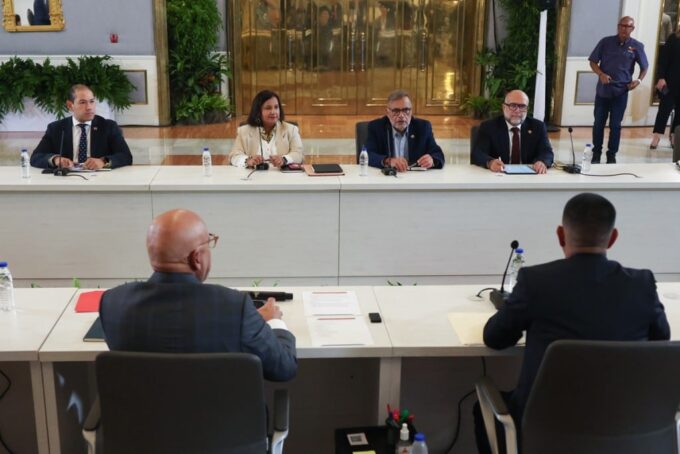
A New Chapter in Venezuela: Negotiations Amidst Hope and Uncertainty
Explore the evolving political landscape in Venezuela as negotiations between the government...
 2 Mins read
María Corina Machado’s Unyielding Pursuit: A Symbol of Resistance Amidst Turbulent Times
Explore the recent struggles of María Corina Machado, a prominent Venezuelan opposition...
2 Mins read
U.S. Issues License for Oil Exploration in Venezuela, Signaling Geopolitical Shift
The U.S. Treasury has authorized oil and gas exploration in Venezuela, marking...
2 Mins read


Ex-CEO of Nodus Bank Sentenced to Nine Years for Financial Misconduct
The former CEO of Nodus Bank has been sentenced to nine years...
2 Mins read

Leave a comment