
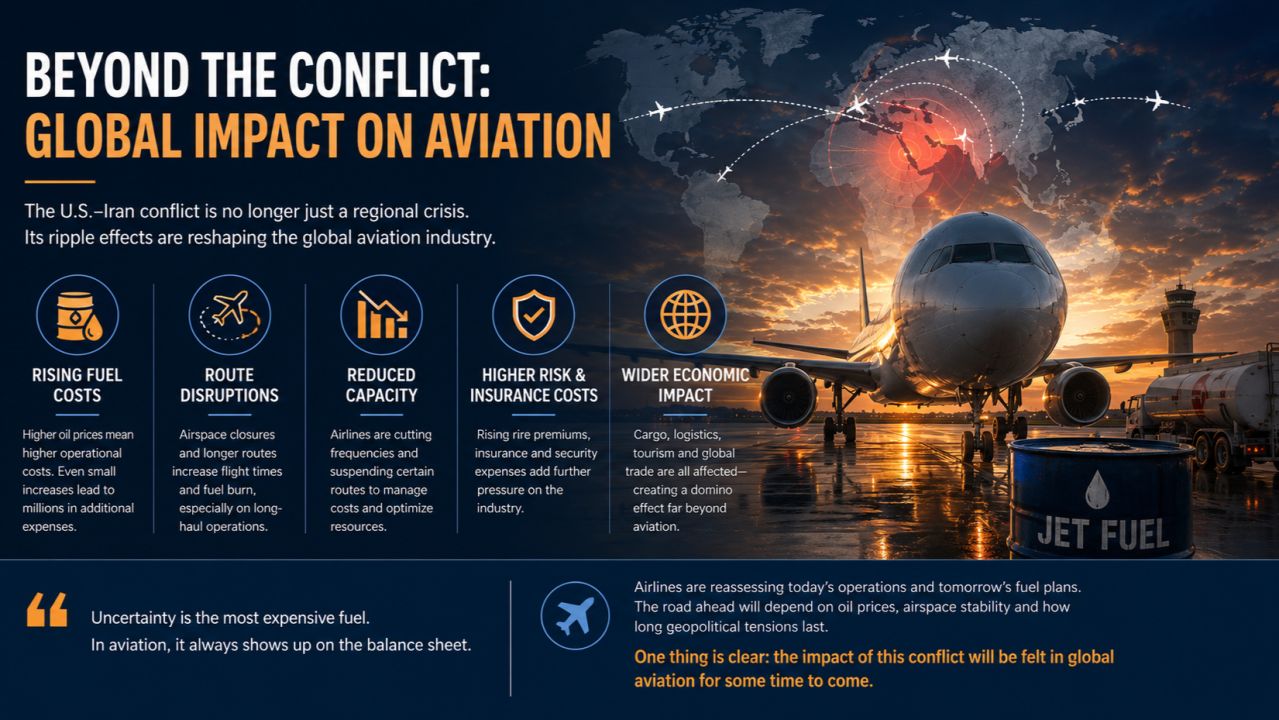
As geopolitical friction between the United States and Iran intensified in May 2026, its first clear collateral victim has been the global aviation system. Energy markets responded swiftly, and with fuel the single largest line item on an airline’s P&L, even modest oil-price movements now carry outsized operational consequences.
The immediate pressure: cost, access and planning
Rising fuel prices are translating into meaningfully higher operating expenses for carriers; even marginal increases can equate to millions in additional costs. Yet today’s challenge extends beyond commodity pricing. Airlines are contending with fuel accessibility and supply continuity concerns that force a rethink of routine fuel planning and day-to-day deployment of resources.
Across regions, carriers have begun recalibrating schedules and operational plans—not merely to curb near-term expenditures but to optimize finite fuel resources amid uncertainty. The practical result: thousands of flights face reduction, rescheduling or cancellation as airlines weigh commercial priorities against resource constraints.
Long-haul services and rising ancillary costs
Long-haul operations are particularly exposed. Airspace restrictions and reroutes lengthen sectors, consuming more fuel and raising trip costs. Simultaneously, insurance and security-related premiums are climbing, layering additional financial pressure on carriers already managing volatile fuel spend.
Some operators are reducing frequencies on sensitive routes; others have opted for temporary suspensions. These are strategic, operational responses reflecting both cost management and risk mitigation—not isolated disruptions but early indicators of a broader industry pivot.
Domino effects beyond passenger flying
The aviation sector does not operate in isolation. Energy-driven shocks propagate through cargo transportation, supply chains, tourism mobility and global trade—sectors whose resilience depends on the continuity and predictability of air links. Uncertainty about how long tensions will persist, or whether sudden airspace closures may recur, converts market volatility into higher operational costs across the board.
What industry stakeholders should watch
In the weeks ahead, three variables will be determinative for aviation planning:
- The trajectory of oil prices and the responsiveness of fuel markets.
- The status of regional airspaces and any new flight restrictions or reroutes.
- The duration and evolution of geopolitical tensions that affect energy and logistics chains.
Airlines, charter operators and corporate flight departments are already reassessing near-term fuel strategies while building contingencies for extended uncertainty. For sectors tied to luxury travel—private jet operators, premium carriers and high-end tourism—these pressures may translate into altered schedules, higher surcharges and more conservative routing until clarity returns.
Key highlights
- Fuel remains the single largest operational cost for airlines; price increases can add millions to carrier expenses.
- Beyond price, fuel accessibility and continuity are emerging as immediate operational risks.
- Thousands of flights could be reduced, rescheduled or cancelled as airlines reallocate resources.
- Long-haul services face magnified exposure due to longer reroutes and higher consumption.
- Insurance, risk premiums and security costs are rising, compounding financial pressure.
- Effects extend to cargo, logistics, tourism mobility and global trade.
Analysis by Alp Er Tunga Ersoy, MBA (May 13, 2026) underscores that the impact of the U.S.–Iran conflict is no longer geographically contained—its operational and economic consequences for aviation will be felt globally for some time.
For industry leaders and travelers alike, the near term will be defined by adaptation. Carriers will continue to refine fuel planning and route strategies while stakeholders across travel, logistics and trade monitor the three pivotal variables of prices, airspace status and geopolitical duration. The balance between maintaining commercial operations and preserving operational resilience will determine who weathers this period with the least disruption.
Make publications with A Bit Lavish in Miami, Florida. Contact us at 305-332-1942







Jetson One 2026: A Personal eVTOL Priced at 148,000 Signals New Era for Recreational Flight
Presented as the world’s first personal air vehicle, the Jetson One 2026...
 ABL2 Mins read

Hybrid‑Electric VTOLs and the Convergence of Aviation and Smart Mobility
Ethen Laing of LAING International frames hybrid‑electric VTOL concepts—exemplified by Manta Aircraft—as...
ABL2 Mins read

Luxury Jet Swaps Cabin Windows for Video Screens
The Future of Air Travel: Windowless Jets and Virtual Views For many...
ABL3 Mins read



Coco Gauff Teams Up with flyExclusive for Exclusive Luxury Jet Experience
Coco Gauff Teams Up With flyExclusive For Luxury Private Jet Travel In...
ABL5 Mins read
