
Illuminating Myths: The Enigmatic Legacy of Romania’s ‘Tank-Melting’ Laser
A Tale Forged in Fear and Folklore
Every conflict breeds its own legends, often as powerful as the weapons wielded in battle. Among these captivating narratives is the story of Romania’s supposed laser weapon, a tale that emerged during the Cold War amidst a backdrop of political tension and military posturing. As the Warsaw Pact tightened its grip on Eastern Europe, Romania found itself caught in a maelstrom of fear and speculation, leading to the birth of a myth that would endure for decades.
The Context of a Nation Under Siege
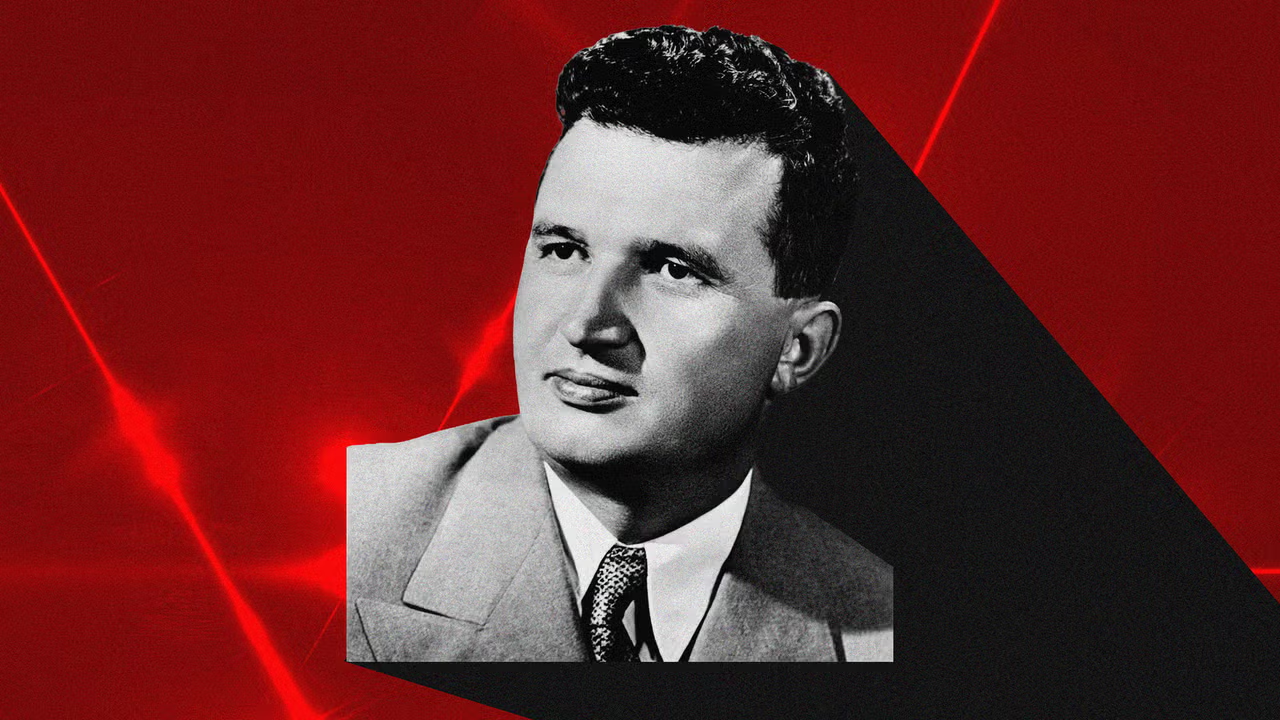
In 1968, after the Warsaw Pact’s invasion of Czechoslovakia, Romania’s atmosphere was thick with apprehension. The nation, led by the infamous Nicolae Ceaușescu, faced an imminent threat from Soviet forces reportedly massing at its borders. It was during this turbulent time that whispers of an extraordinary weapon began to circulate. According to folklore, Ceaușescu received alarming warnings from foreign dignitaries, propelling him to hastily deploy troops to the border—not just with conventional arms but with vehicles equipped with advanced laser technology.
The Mystery of Coandă’s Laser
The legendary weapon, attributed to the inventive mind of Henri Coandă, was said to harness the power of lasers to incapacitate Soviet tanks. As the story goes, when confronted by the advancing Soviet army, Romanian soldiers activated these mysterious devices, causing enemy armor to melt away as if under the spell of a superheated beam. This dramatic tableau of defiance painted Romania not just as a passive observer but as a formidable player on the Cold War chessboard.
Unraveling the Myth
While the tale captures the imagination, the veracity of Romania’s laser weapon remains unsubstantiated. Historical scrutiny reveals a lack of credible evidence: no verified accounts, no photographs, and no schematics have surfaced to confirm that such a system existed or was ever operational. The reality was that, like many nations during this era, Romania was engaged in nascent laser research, spearheaded by physicists such as Ion Agârbiceanu, who developed early gas lasers. However, the idea of a combat-ready laser weapon in the field during this period is more fiction than fact.
A Reflection of Political Strategy
The narrative of Romania’s laser weapon served a strategic purpose for Ceaușescu, positioning the country as a defiant outlier within the Eastern Bloc. His vehement condemnation of the invasion of Czechoslovakia was not merely rhetoric; it was a calculated move to assert Romania’s independence and reinforce its image as a bastion of resistance against Soviet dominion. The legend of a domestic superweapon complemented this image, instilling a sense of national pride and resilience among the populace.
The Power of Perception
Much like the broader Cold War narrative of laser weapons, the Romanian myth highlights the potency of perception over reality. During this era, both East and West were embroiled in a battle of narratives, each side weaving tales of technological superiority to bolster their defense postures. The U.S. grappled with fears of a “laser gap,” believing that the Soviet Union was on the verge of deploying advanced directed energy weapons, a notion fueled by intelligence reports and public sentiment. Yet, as with Romania’s laser, much of this apprehension existed more in the realm of speculation than in operational capability.
The Enduring Allure of the Laser Legend
Even in contemporary times, as actual laser technologies transition from prototype to battlefield application, the allure of these stories remains potent. The narrative of Romania’s supposed tank-melting laser continues to resonate, reminding us that sometimes the most effective weapon is not the technology itself, but the story behind it. As Romanian folklorist Constantin Eretescu aptly noted, the legend served to “excite the people’s patriotism,” suggesting that even in the absence of real superweapons, the belief in their existence could galvanize a nation’s spirit.
In the grand tapestry of Cold War history, Romania’s laser weapon stands as a testament to the intersection of innovation, myth, and national identity. It illustrates how, in times of uncertainty, the power of a captivating story can forge a legacy that transcends mere facts, inspiring generations to believe in the impossible.
Editorial note: This article was created by A Bit Lavish Miami’s Magazine as an original editorial reinterpretation based on publicly available reporting. Original source: fastcompany.com. Read the original article here: https://www.fastcompany.com/91585347/the-cold-war-legend-of-romanias-tank-melting-laser.
Images are used for editorial reference with source credit. If an image requires correction or removal, please contact A Bit Lavish.









Bitcoin Surges Above $85,000, Reaching an 8-Month High
Bitcoin's recent price surge to $85,000 marks a pivotal moment in the...
 1 Mins read

Bitcoin Price Surges Past $81,000, Signaling Strong Market Recovery
The recent surge in Bitcoin's price past $81,000 indicates a robust recovery...
2 Mins read

Navigating the Future: Insights from Cisco’s Chuck Robbins on AI and Leadership
Cisco's CEO Chuck Robbins shares his insights on business leadership in the...
3 Mins read



A New Era for Toys ‘R’ Us: Reinventing Retail in 2026
Toys ‘R’ Us is making a significant comeback with plans for 120...
2 Mins read
