
Navigating the New Landscape of AI and Election Integrity
The Rise of AI in Political Campaigning
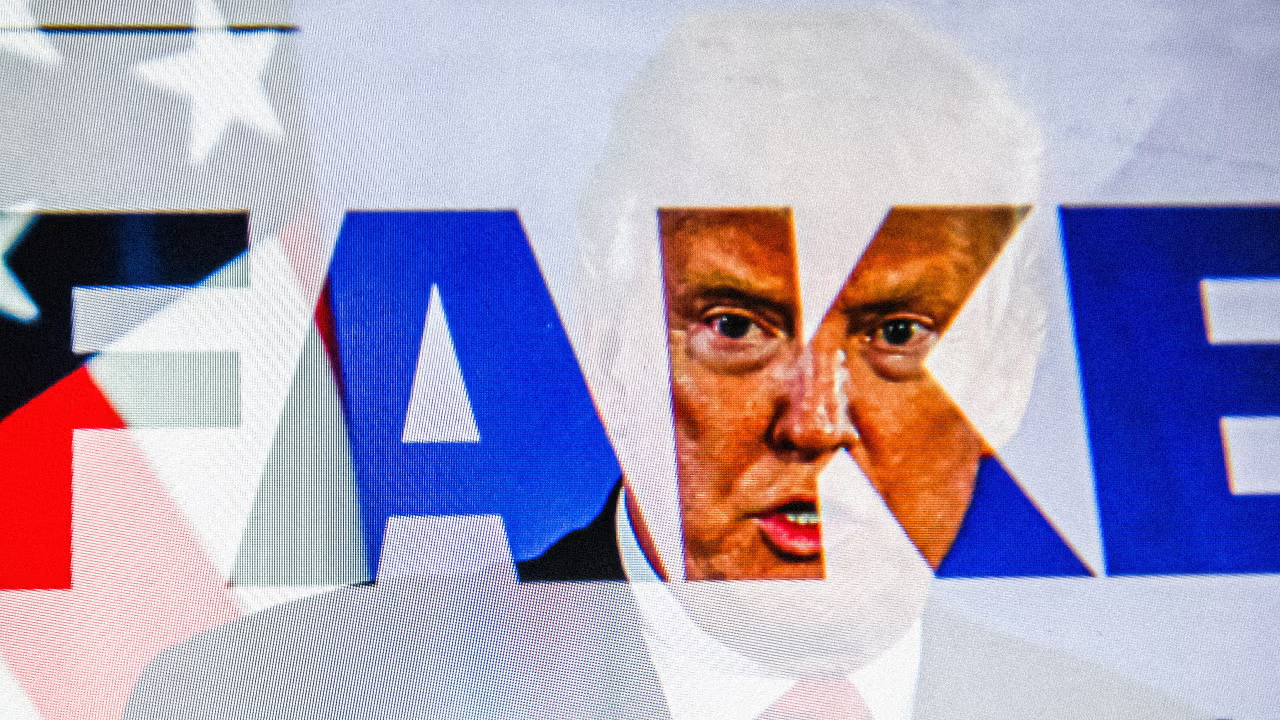
The political landscape is undergoing a seismic shift as artificial intelligence (AI) technology becomes increasingly intertwined with election campaigns. Imagine a campaign video wherein a candidate appears to confess to a crime, only to discover that the entire scene has been fabricated using AI. Such scenarios are no longer confined to the realm of fiction. As we approach the 2026 midterm elections, the implications of AI-enhanced political content present significant challenges for voters, policymakers, and campaign strategists.
State Legislation: A Patchwork Response
In response to the evolving challenges posed by AI, several states have enacted laws aimed at regulating the use of AI-generated political content. According to a report by the National Conference of State Legislatures, as of June 2026, 31 states have addressed the issue of election deepfakes, with varying degrees of stringency. California and Texas initiated their legislation as early as 2019, but a wave of new laws emerged post-2024, reflecting a growing recognition of the need for regulatory frameworks.
Among these states, 28 have mandated disclosures for AI-generated content, while Maryland, Minnesota, and Texas have taken a firmer stance by prohibiting certain types of election deepfakes outright, even if they include disclaimers. This patchwork of regulations raises critical questions about the effectiveness and enforcement of these laws in protecting voters from misinformation.
Disclosure vs. Prohibition: Divergent Approaches
The varying legal frameworks highlight a fundamental difference in approach. For instance, Louisiana’s June 2026 law requires explicit warnings on campaign materials that utilize AI technology to misrepresent candidates. This law applies to various media, including printed materials and online advertisements, allowing fabricated content to remain in circulation as long as it carries the necessary disclosure. However, this does not extend to federal candidates, meaning that voters could be exposed to potentially misleading content without any warning.
Conversely, Maryland’s law adopts a more prohibitive stance, disallowing certain deceptive deepfakes regardless of whether they are labeled as AI-generated. This approach requires proof that the creator acted with intent to mislead voters, complicating the enforcement landscape. While this may protect voters from blatant misinformation, it also raises issues about the subjective nature of determining intent and harm.
The Role of Warnings in Voter Perception
Research indicates that while warnings about AI-generated content can foster skepticism among viewers, their effectiveness in changing voting behavior remains uncertain. A study conducted in 2025 revealed that while those who viewed labeled misleading AI content were less likely to believe the claims, the presence of a warning did not significantly alter their willingness to engage with such content.
This raises a crucial point: merely labeling content as AI-generated does not equip voters with the tools necessary to discern its truthfulness. With the rapid proliferation of AI-generated political advertisements—estimated to account for a substantial portion of campaign spending—voters may find themselves navigating an increasingly murky informational landscape.
Challenges in Enforcement
The enactment of laws does not guarantee their enforcement. A notable legal challenge arose in September 2026 when a federal judge temporarily blocked Montana’s deepfake law, citing potential infringements on free speech rights. The implications of such rulings highlight the ongoing tension between safeguarding electoral integrity and upholding constitutional freedoms.
Moreover, the decentralized nature of the U.S. electoral system means that enforcement mechanisms can vary widely from state to state. In Louisiana, for instance, local district attorneys hold significant discretion in prosecuting violations, while Maryland’s electoral officials have been empowered to correct misinformation actively. This inconsistency may lead to gaps in voter protection, raising concerns about whether voters can truly trust the information presented to them.
Looking Ahead: The Future of AI in Elections
As the 2026 elections draw near, the intersection of AI technology and political campaigning will only become more pronounced. The state laws that have emerged thus far represent a crucial step toward addressing the challenges posed by AI-generated misinformation. However, their limitations underscore the need for a cohesive national strategy that balances the imperative of protecting electoral integrity with the rights of free expression.
For voters in Miami and beyond, the onus will be on individual discernment in an era where the lines between reality and deception are increasingly blurred. As we navigate this new landscape, it is essential to remain vigilant and informed, ensuring that our electoral decisions are based on accurate and trustworthy information.
Editorial note: This article was created by A Bit Lavish Miami’s Magazine as an original editorial reinterpretation based on publicly available reporting. Original source: fastcompany.com. Read the original article here: https://www.fastcompany.com/91615997/states-laws-struggling-ai-election-deepfakes.
Images are used for editorial reference with source credit. If an image requires correction or removal, please contact A Bit Lavish.









Empowering Your Career: The Art of Setting Boundaries
Discover how setting boundaries can transform your career and enhance leadership potential,...
 3 Mins read

G7 Announces Immediate Release of 100 Million Barrels of Oil in Response to Trump Threat
The G7's decisive action to release oil underscores the geopolitical tensions surrounding...
2 Mins read
G7 Nations Agree to Release 100 Million Barrels of Oil and Diesel Stocks Amid U.S. Policy Shift
The G7's recent decision to release significant oil and diesel stocks, coupled...
2 Mins read


Trump Promises Nearly $100 Cash Giveaway to Seniors
The former president's latest initiative aims to support 20 million seniors, raising...
1 Mins read

Leave a comment