
Navigating the Shifting Sands of Home Equity: Insights for Today’s Homeowners

Understanding the Current Landscape
The real estate market is in constant flux, and recent data reveals a significant shift in home equity among U.S. homeowners. According to a report by Attom, the percentage of equity-rich homes—those where the mortgage balance is less than half of the home’s estimated market value—has reached a near five-year low. In the second quarter of 2026, only 41% of mortgaged homes were classified as equity-rich, a drop from 43% at the start of the year and down from 47% a year prior.
A Deeper Dive into the Numbers
This decline marks the fourth consecutive quarter of diminishing equity-rich status among homeowners, an indicator that merits attention. While other economic indicators may suggest stability, the housing equity landscape paints a more nuanced picture. A troubling 3.2% of homes are now categorized as ‘seriously underwater,’ meaning that their loan balances exceed their market values by more than 25%. Although this figure has remained steady from earlier in the year, it signifies a 2.7% increase compared to the previous year.
State-by-State Variations
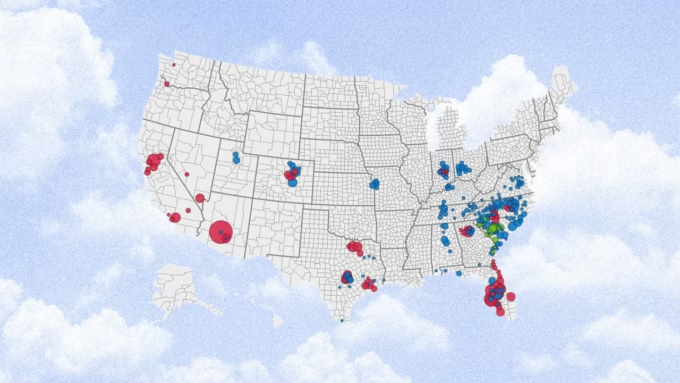
The dynamics of home equity are not uniform across the United States. In fact, local stories reveal a diverse array of trends. For instance, while 13 states reported a rise in equity-rich homes quarter-over-quarter, only four states saw year-over-year increases. North Dakota emerged as a leader, boasting a nearly three percent increase in equity-rich homeowners. Conversely, states like Minnesota experienced a stark decline, plummeting from 38% to just 20% equity-rich status.
Winners and Losers in the Equity Game
Some states have established themselves as havens of home equity. Vermont holds the highest percentage of equity-rich homeowners at 79%, followed closely by regions such as Montana, Rhode Island, South Dakota, and New Hampshire, where over half of mortgaged homes are equity-rich. However, the landscape is not so rosy for all. In states like Michigan, California, and Washington, the share of equity-rich homes has dropped by 10% or more—a trend that raises questions about the broader implications for homeowners and potential buyers.
The Implications for Homeowners and Buyers
As Miami continues to thrive as a vibrant hub for real estate investment, understanding these shifts in home equity is crucial for both current homeowners and prospective buyers. For those who purchased homes between 2022 and 2025, the current market conditions may pose unique challenges, particularly for those who find themselves in the ‘seriously underwater’ category. The financial resilience that home equity once provided may be diminishing, prompting a reevaluation of investment strategies and financial planning.
Looking Ahead: What Homeowners Should Consider
With 18 states witnessing a rise in seriously underwater homes and 33 states experiencing year-over-year increases, it is essential for homeowners to stay informed and proactive. Whether considering refinancing options, home improvements, or even strategic sales, the evolving market landscape necessitates a thoughtful approach. For Miami’s luxury market, where demand remains high, potential homeowners should weigh their options carefully, ensuring that they are not only investing in a property but also safeguarding their financial future.
Conclusion: The Path Forward
As the housing market continues to shift, homeowners must navigate these changes with a keen eye on equity dynamics and broader economic indicators. Understanding these trends provides an opportunity for strategic decision-making, allowing homeowners to adapt to the realities of the current market. In a city as dynamic as Miami, where the intersection of innovation and real estate is ever-present, staying ahead of the curve will be crucial for those looking to secure their place in this competitive landscape.
Editorial note: This article was created by A Bit Lavish Miami’s Magazine as an original editorial reinterpretation based on publicly available reporting. Original source: fastcompany.com. Read the original article here: https://www.fastcompany.com/91593049/bought-a-home-between-2022-and-2025-you-could-be-most-vulnerable-to-this-housing-market-shift.
Images are used for editorial reference with source credit. If an image requires correction or removal, please contact A Bit Lavish.







Berkshire Hathaway’s Strategic Embrace: The Taylor Morrison Acquisition
Discover how Berkshire Hathaway's acquisition of Taylor Morrison shapes the future of...
 3 Mins read

Navigating the $40 Trillion Milestone: A Critical Look at America’s Fiscal Future
The recent surge in U.S. national debt to over $40 trillion raises...
 ABL2 Mins read

Illuminating the Future: The Economic Vitality of America’s Family Farms
Exploring the critical role of family farms in sustaining local economies and...
ABL3 Mins read



Transforming Side Hustles into Success: Five Small Business Ventures to Elevate Your Career
Explore innovative small business ideas that can be launched alongside your 9-to-5...
ABL3 Mins read

Leave a comment