
The Curious Case of the Missing Banana: Cattelan’s Comedian Revisited
 ABLUpdated 4 months Ago2 Mins read153

The Art of Provocation
In the ever-evolving landscape of contemporary art, few works have sparked as much conversation and controversy as Maurizio Cattelan’s ‘Comedian’. This installation, which features a banana duct-taped to a wall, transcends mere absurdity to engage with deeper themes of value, consumerism, and the nature of art itself. As collectors and enthusiasts flock to Miami’s vibrant art scene, the recent theft of this iconic piece from the Centre Pompidou-Metz serves as a compelling reminder of the fragility and volatility inherent in the art market.
Provenance and Perception
Art is often defined by its context and history, and Cattelan’s work is no exception. The banana, a seemingly mundane object, becomes a vessel for exploring the interplay between art and commerce. The installation’s initial reception was a complex tapestry woven with threads of humor, critique, and a challenge to traditional notions of artistic value. As collectors reflect on their investments, the narrative surrounding a piece like ‘Comedian’ enhances its allure and market significance.
The Theft: A Cultural Commentary
On a seemingly ordinary Saturday, the unexpected occurred: the banana element of ‘Comedian’ vanished. This act of theft not only raised eyebrows but also reignited discussions about the nature of art in an age where the boundaries of authenticity and ownership are increasingly blurred. The swift restoration of the installation post-theft underscores the inherent irony of the piece—what is truly valuable? Is it the banana itself, or the concept behind it? Such questions resonate deeply within the collector community, driving a psychological engagement with art that goes beyond aesthetic appreciation.

Rarity and Market Implications
The art market thrives on rarity and the narratives that surround unique pieces. Cattelan’s work, characterized by its playful yet profound commentary on society, is a prime example of how an artist’s legacy can elevate a work’s market value. The circumstances surrounding the theft have only intensified interest, casting ‘Comedian’ as a cultural artifact that encapsulates the zeitgeist of our time. For collectors, investing in such pieces is not merely a financial decision; it is an engagement with the dialogues that shape contemporary culture.
The Collector’s Psychology
For those immersed in the world of art, the psychology of collecting is as intricate as the works themselves. The allure of owning a piece with a story—especially one as quirky and controversial as ‘Comedian’—is undeniable. Collectors are drawn not only to the aesthetic qualities but also to the narratives that accompany each piece. This phenomenon is particularly pronounced in Miami, where a rich tapestry of cultural influences converges, creating an environment ripe for innovative artistic expressions and investment opportunities.
Art as a Living Entity
Ultimately, the saga of Cattelan’s ‘Comedian’ serves as a reminder that art is not static; it is a living entity that evolves with time and context. The dialogues it inspires, the controversies it incites, and the emotional responses it elicits are integral to its existence. As Miami continues to flourish as a global hub for art and culture, the theft of ‘Comedian’ invites us to reflect on the deeper meanings we assign to art and its place in our lives.
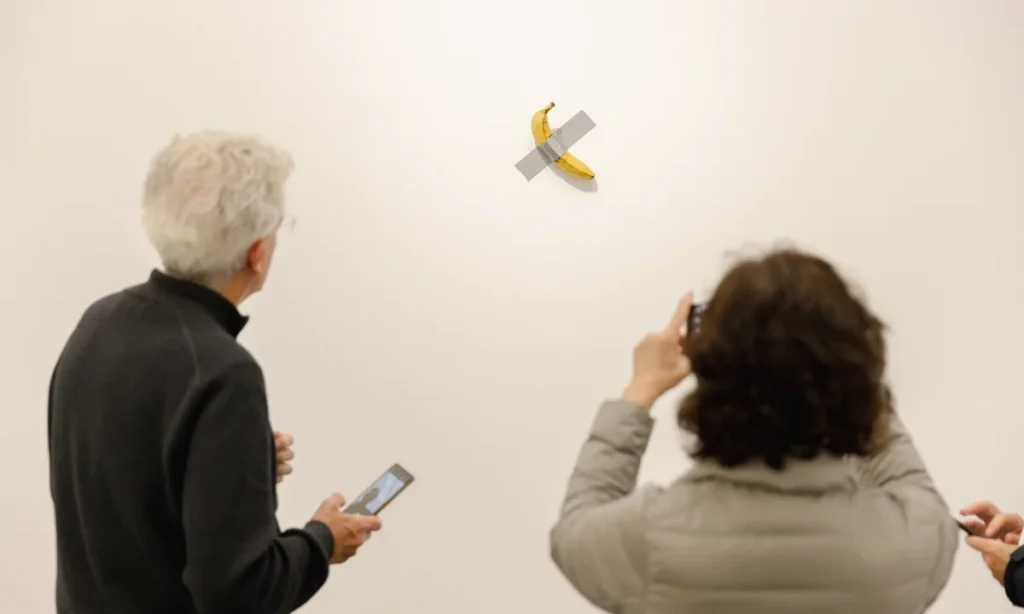
Editorial note: This article was created by A Bit Lavish Miami’s Magazine as an original editorial reinterpretation based on publicly available reporting. Original source: theartnewspaper.com. Read the original article here: https://www.theartnewspaper.com/2026/06/01/gone-bananas-cattelans-comedian-stolen-from-centre-pompidou-metz-exhibition.
Images are used for editorial reference with source credit. If an image requires correction or removal, please contact A Bit Lavish.




A Celebration of Heritage: The Ukrainian Museum’s 50th Anniversary and Its Artistic Tribute
Explore the Ukrainian Museum in New York's 50th anniversary, highlighting an artistic...
ABL2 Mins read
A Call to Action: The Whitney Museum Workers Stand for Change
Exploring the implications of the Whitney Museum workers' decision to strike, we...
 2 Mins read
Navigating the Waters of Art Restitution: A California Test Case
Exploring the implications of recent lawsuits concerning Nazi-looted art and the potential...
2 Mins read
A New Era at the Vancouver Art Gallery: Co-Leadership and Vision
Explore the transformative leadership of Eva Respini and Sirish Rao at the...
3 Mins read