


Redefining Boundaries in the Creator Economy
The landscape of digital content creation is undergoing a seismic shift as artificial intelligence becomes increasingly integrated into the creative process. This evolution is not just about technological advancement; it raises profound ethical questions about authenticity, transparency, and trust. As we witness this transformation, a recent incident involving popular science communicator Hank Green serves as a striking case study of how AI is reshaping the creator community.
The Incident That Sparked Outrage
In a video produced by Complexly—a nonprofit established by Green that oversees educational channels like CrashCourse and SciShow—viewers detected unusual phrasing that led to speculation regarding AI involvement in the script’s creation. A seemingly innocuous phrase, “I appreciate the pushback,” ignited a firestorm of debate. Users began to wonder if it was a remnant of an AI prompt, spawning a discussion that quickly escalated beyond mere curiosity.
Green, recognizing the backlash, promptly clarified his stance. He admitted to utilizing AI tools like ChatGPT during the research phase to assist in finding credible sources. However, he assured his audience that the contentious phrase was not a product of AI. “I was relying too much on generated notes,” he remarked, underscoring the potential pitfalls of over-reliance on technology in creative endeavors.
Public Sentiment and the Weight of Expectations
Despite his clarifications, the reaction from the community was anything but forgiving. Longtime fans expressed their disappointment, believing that someone of Green’s stature should remain above the fray of AI’s dubious ethics. Comments like, “I am so disappointed. Someone like Hank Green would be the last person I’d ever imagine using AI like this,” reflected a broader sentiment among followers who had long trusted his commitment to authenticity and credible sourcing.
This backlash underscores a critical aspect of the creator economy: the expectations placed upon public figures. For many fans, the line between human creativity and machine-generated content is not just blurred—it is a chasm that they believe should remain uncrossed by their favored creators.
The Apology: A Double-Edged Sword
In an attempt to quell the uproar, Green took to Reddit to issue a heartfelt apology, acknowledging the disappointment felt by his audience. “I’m mortified that I have let so many people down,” he stated, indicating a willingness to reassess his creative processes. Yet, instead of bringing closure, his apology seems to have further ignited the conversation on the ethics of AI usage among creators.
Some commentators have described his situation as a form of “self-canceling,” where the act of apologizing feels insufficient to restore trust. This reaction highlights a troubling trend within the creator community, where transparency and accountability are increasingly demanded, yet rarely reciprocated.
Decoding the AI Acceptance Spectrum
The incident with Green has sparked an essential dialogue about the acceptable boundaries of AI use within the creator community. Notably, the reactions vary significantly from one creator to another. Some creators are embraced for their open use of AI tools, while others face severe backlash for even the slightest hint of AI involvement.
“It seems really arbitrary which camp is which,” one user remarked on social media, pointing to the inconsistencies in community standards. This raises critical questions about the criteria that define acceptable AI use and the precarious balance between innovation and authenticity.
A New Paradigm for Creators
As the lines between human creativity and artificial intelligence continue to blur, the creator community must navigate this complex landscape with care. The case of Hank Green serves as a poignant reminder of the challenges faced by public figures in an era of rapid technological advancement. Creators must reconsider their relationship with AI, not just as a tool for efficiency but as a potential disruptor of trust and authenticity.
For Miami’s vibrant creative scene, this issue resonates deeply. As a hub for innovation and creative expression, understanding the implications of AI on content creation is vital. Local creators must engage in this discourse to define their own ethical frameworks, ensuring that their work remains genuine while embracing the benefits of technology.
Ultimately, the future of content creation will hinge on how creators incorporate AI into their work while maintaining the trust and engagement of their audiences. The path forward will not only shape individual careers but will also redefine the very nature of the creator economy.
Editorial note: This article was created by A Bit Lavish Miami’s Magazine as an original editorial reinterpretation based on publicly available reporting. Original source: fastcompany.com. Read the original article here: https://www.fastcompany.com/91584241/hank-green-ai-backlash-fan-reaction-impact-on-creator-community.
Images are used for editorial reference with source credit. If an image requires correction or removal, please contact A Bit Lavish.






Navigating the New Landscape of Home Affordability: A Deep Dive into Market Trends
Explore the evolving dynamics of home affordability in the U.S. housing market...
 2 Mins read
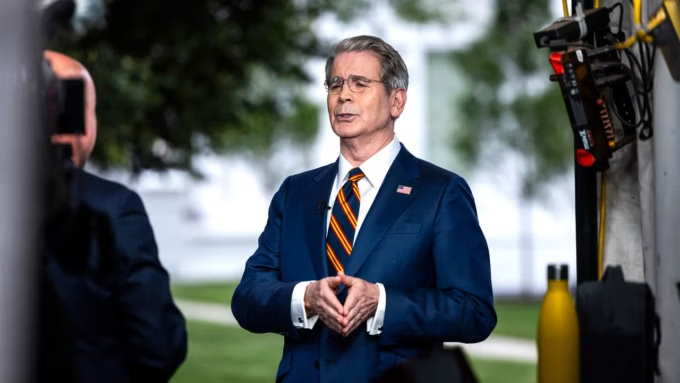
Rethinking Economic Narratives: The End of the K-Shaped Economy?
Treasury Secretary Scott Bessent declares the end of the K-shaped economy, but...
2 Mins read
Fantasy Baseball Trade Deadline Spurs Strategic Shifts in Bullpen Dynamics
The August 2026 trade deadline reshapes bullpen roles, impacting team strategies and...
1 Mins read



Jefry Yan Celebrations Mark a New Era in Major League Baseball
The global sports community recognizes Jefry Yan's achievements, highlighting the evolving landscape...
1 Mins read

Leave a comment