
The Shifting Landscape of AI Hardware: Huawei’s Rise in China
Redefining Competition in AI Hardware
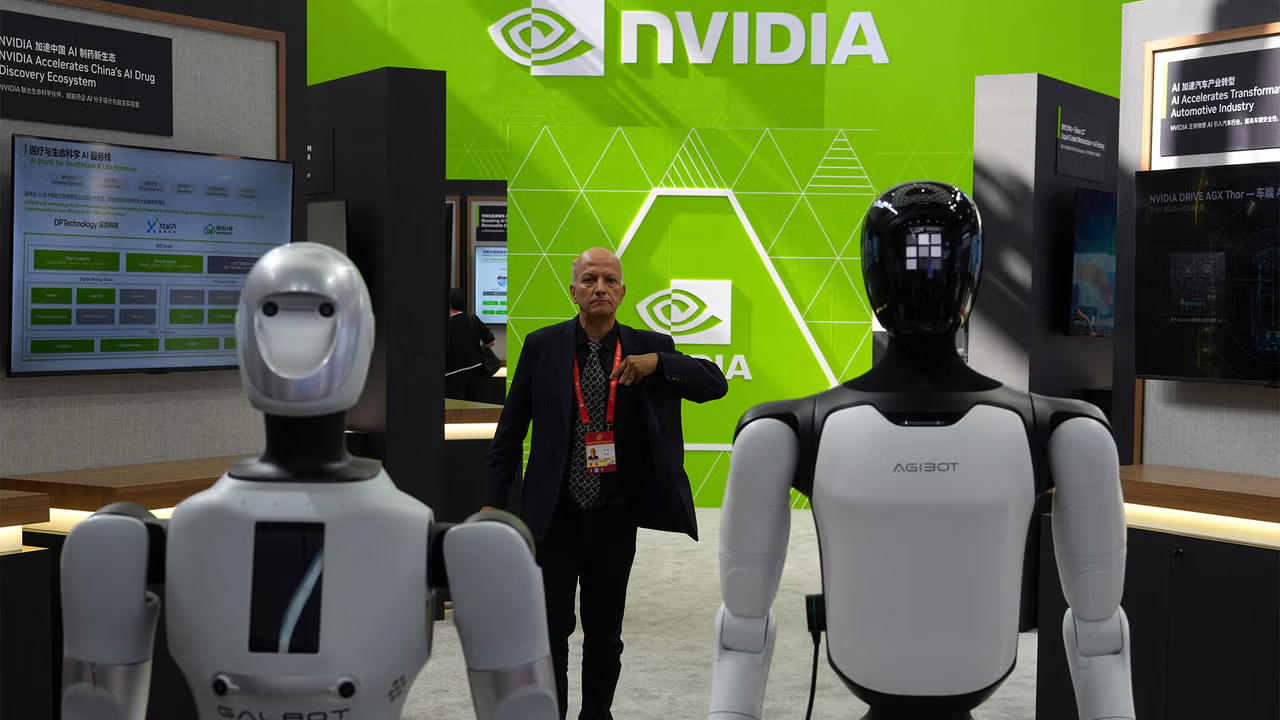
In the rapidly evolving world of artificial intelligence, the battle for supremacy in hardware and computing power is intensifying, particularly between the U.S. and China. As domestic companies like Huawei strengthen their foothold, established giants such as Nvidia are witnessing a significant decline in their market shares within China. This shift not only reflects the changing dynamics of the semiconductor industry but also highlights broader geopolitical tensions that are redefining market strategies.
Huawei’s Ascent in a Controlled Market
Over the past few years, Huawei has emerged as a formidable competitor in China’s AI chip sector. Following stringent U.S. export controls that have hampered the sales of advanced technologies to China, Huawei and other local firms have accelerated their efforts to achieve technological self-sufficiency. Jensen Huang, Nvidia’s CEO, acknowledged that the company once dominated the Chinese market with a 95% share but has seen its influence dwindle as Huawei has ascended to prominence.
Recent estimates suggest that Nvidia’s market share in China’s AI chip sector could plummet to around 8% this year, while Huawei’s share is expected to grow to approximately 50%. This dramatic shift underscores not just Huawei’s growth, but also the implications of international trade policies that have prompted local companies to innovate and compete fiercely.
The Emergence of Local Innovators
In addition to Huawei, other Chinese firms are making significant strides in the AI chip arena. Companies like DeepSeek are pushing the boundaries of chip performance and cost-effectiveness, fostering an environment where domestic products are increasingly viewed as viable alternatives to established foreign technologies. Analysts suggest that Huawei’s Ascend 950 series shows comparable capabilities to Nvidia’s H200, marking a notable advancement in China’s semiconductor capabilities.
As these developments unfold, the Chinese government is actively encouraging the use of locally designed chips, reinforcing a narrative of self-reliance in technological capabilities. According to He Hui, a semiconductor research director, China’s commitment to self-sufficiency has never been stronger, as local firms leverage government support to enhance their R&D efforts.
The Global Supply Chain Challenge
However, while Huawei and its peers make headway in the domestic market, the global semiconductor supply chain remains intricately linked. Nvidia continues to play a crucial role in the AI landscape, with its designs at the forefront of cutting-edge technology. Despite the restrictions, demand for Nvidia’s products in China persists, as evidenced by recent smuggling cases aimed at circumventing export limitations.
Notably, Nvidia’s reliance on advanced manufacturing processes underscores the complexity of the semiconductor industry. The company’s chips are produced using highly specialized machinery from ASML, which is also off-limits to Chinese manufacturers due to U.S. trade restrictions. This interdependence, coupled with the reality that certain Chinese innovations still depend on Nvidia’s technology, illustrates the nuanced nature of competition in this field.
Looking Ahead: The Future of AI in China
As Huawei and other Chinese firms continue to innovate, the landscape of AI technology is poised for transformation. DeepSeek’s recent advancements, including adaptations for Huawei’s Ascend chips, highlight the potential for homegrown solutions to fill the void left by Nvidia. Nonetheless, analysts caution against an abrupt transition to Huawei’s technologies, suggesting that while local firms are gaining ground, a complete takeover of the market will take time.
Nvidia remains optimistic about its future prospects, projecting significant revenue growth despite the challenges posed by the Chinese market. The company anticipates a revenue surge driven by the global demand for AI technology, even as it grapples with the restrictions on its most advanced chips in China. The resilience of its business model illustrates the complexities of navigating a landscape that is increasingly defined by geopolitical factors.
A Strategic Outlook for Global Players
As the competition heats up, it is essential for global players to adapt their strategies. Huawei, now the world’s largest supplier of telecommunications equipment, is eyeing expansion beyond its borders, aiming to capture market share in regions like Southeast Asia. The implications of China’s push for technological self-sufficiency are profound, suggesting that the global semiconductor landscape will continue to evolve rapidly.
Ultimately, the interplay between local innovation and international competition will shape the future of AI technology. As companies like Huawei redefine what it means to be competitive in this space, traditional leaders like Nvidia must reassess their strategies to maintain relevance in a market that is no longer dictated solely by historical power dynamics.
Editorial note: This article was created by A Bit Lavish Miami’s Magazine as an original editorial reinterpretation based on publicly available reporting. Original source: fastcompany.com. Read the original article here: https://www.fastcompany.com/91566663/nvidias-ai-chip-sales-are-stalling-in-china-heres-whos-gaining-market-share.
Images are used for editorial reference with source credit. If an image requires correction or removal, please contact A Bit Lavish.








Guardians of Innovation: The Rising Tide of Security Workers in Silicon Valley
Explore the critical role of security workers in Silicon Valley's AI landscape...
 2 Mins read

The New Chapter in AI: How Book Acquisitions are Reshaping Language Models
Explore how AI companies are acquiring physical books to enhance training for...
2 Mins read

Reassessing the Impact of Cell Phone Bans in Schools: A Miami Perspective
Explore the nuanced effects of cell phone bans in schools, with insights...
2 Mins read



Navigating the AI-Infused Entertainment Landscape: The Rise of ‘Bad Cat’
Explore the intriguing intersection of AI and nostalgia in entertainment with the...
2 Mins read
